


What Canadian Coins Are Silver?
If you’re holding onto an old Canadian dime, quarter, or dollar, there’s a great chance it contains silver, a precious metal historically valued alongside gold for wealth preservation.
This guide answers the question “What Canadian coins are silver?” in detail to help you quickly identify which ones qualify and what they may be worth today.
Canadian Silver Coins Explained
Most Canadian coins dated 1968 and earlier contain real silver. This precious metal was the standard in circulating coins, from dimes and quarters to half dollars and dollars.
But after 1968, silver was removed from regular circulation.
Any coin you find in your pocket change today, whether it's a quarter, loonie, or toonie, is made of nickel, steel, or other base metals, not silver.
That said, Canada still mints silver coins today, but these are issued as bullion or commemorative pieces rather than for circulation. They’re intended for investment and collecting, not everyday use.
Historic Circulation Silver Coins
Pre-1920 (92.5% silver)
These early Canadian coins were made of sterling silver (92.5% purity), the highest silver content ever used in Canada's circulating coinage.
That means everyday Canadians once used coins in regular transactions that were made of nearly pure silver, which is something we don’t see today.
Below are this era's sterling silver coins:
- 5-cent piece (1858–1919)
- Dime (1858–1919)
- Quarter (1870–1919)
- Half Dollar (1870–1919)
1920–1967 (80% silver)
After World War I and leading into the Great Depression, the global price of silver began to rise, making it more challenging for governments to justify using high-purity silver in everyday coinage.
To reduce costs without eliminating silver altogether, Canada lowered the purity from 92.5% to 80% starting in 1920.
Midway through this period, Canada introduced the silver dollar coin in 1935. It followed the same 80% silver standard and became a notable addition to the country’s circulating silver coin lineup.
All in all, here are the key coins from this period:
- Dime (1920–1967)
- Quarter (1920–1967)
- Half Dollar (1920–1967)
- Silver Dollar (1935–1967)
1967–1968 (50% silver)
This brief period marked a transitional phase as Canada began phasing silver out of its coinage, reducing the silver content in dimes and quarters from 80% to 50%.
These coins were among the last to contain silver before the country shifted entirely to base metals in 1969:
- Dime (1967–1968)
- Quarter (1967–1968)
Modern Canadian Silver Coins (Bullion & Commemorative)
Today, Canadian silver coins are no longer used in everyday circulation. Instead, silver is reserved for two main categories: bullion coins and commemorative coins, both produced by the Royal Canadian Mint (RCM).
Canadian Silver Maple Leaf Coin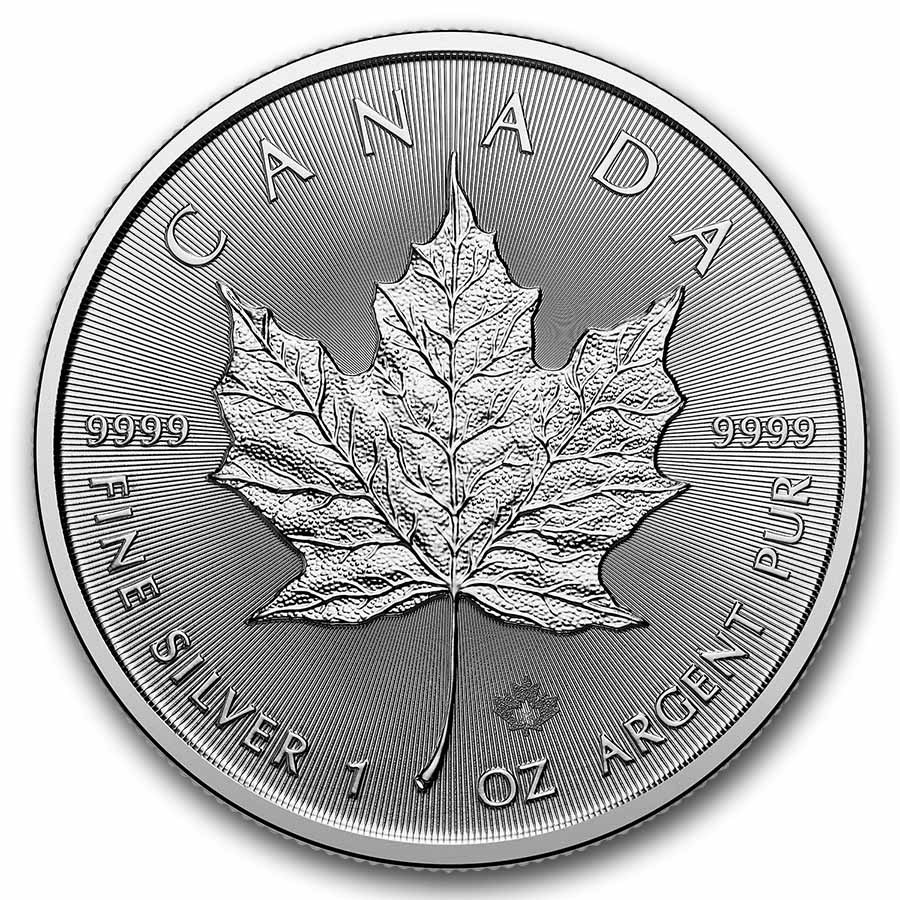 The Canadian Silver Maple Leaf is one of the most recognized and trusted silver bullion coins in the world, introduced by the RCM in 1988.
It’s not a circulation coin but rather a bullion piece meant for investment, wealth preservation, or collection.
Each coin is struck in 1 troy ounce of .9999 fine silver, which is one of the highest purity standards for bullion.
Moreover, it carries a face value of CAD $5. Although its market value is tied to the price of silver, the face value legally classifies it as Canadian currency.
Canadian Commemorative Silver Coins
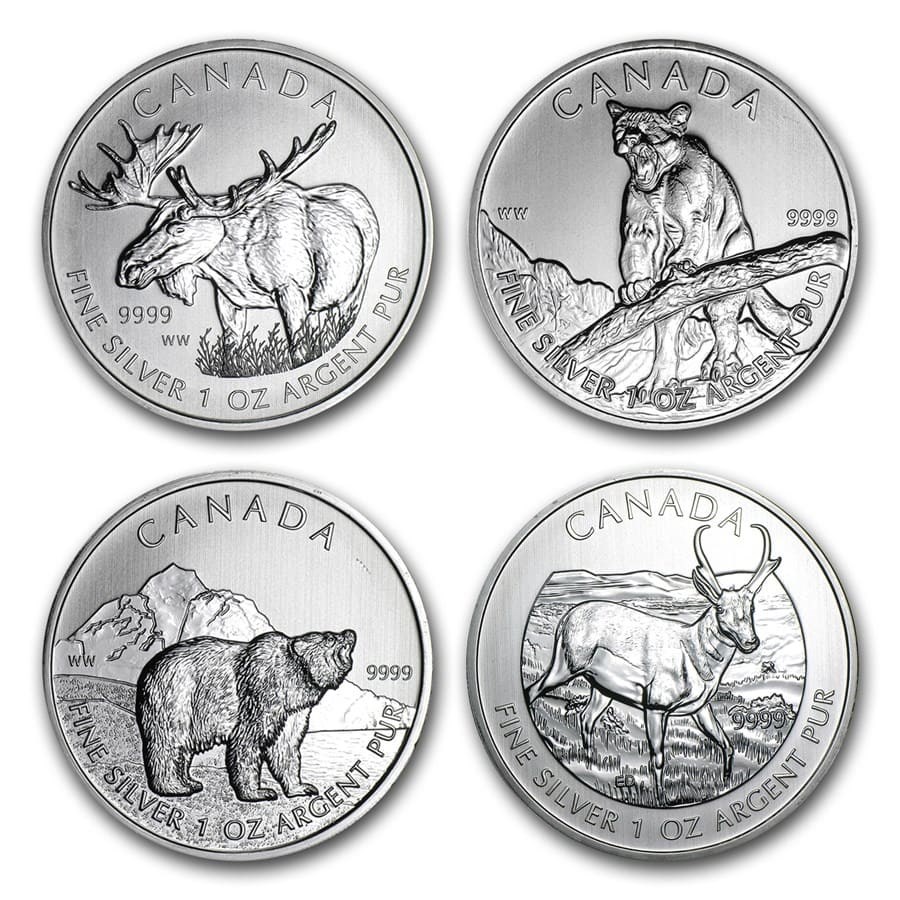
Commemorative silver coins are special-issue pieces often released in themed sets, proof finishes, and spectacularly unique designs. The most popular ones include:
- The 2010 Vancouver Winter Olympics silver coins
- The Wildlife Series (2011–2013)
- The Lunar New Year silver coin series
- Historical commemoratives like the 1867–1992 Canada 125th anniversary series.
As you can see, these limited-edition silver coins are minted to honor special events, notable anniversaries, or historical figures.
That’s to say, commemorative coins are better suited for collecting and sentimental value rather than investment, for which the Silver Maple Leaf coin is designed.
Many commemorative issues still contain .999 fine silver and carry legal tender status. However, their value as collectibles often exceeds face value and, in some cases, even melt value, largely due to rarity and limited mintages.
Canadian Coins That Don’t Contain Silver
Coins minted after 1968 for regular circulation, such as modern nickels, dimes, quarters, loonies, and toonies, don’t contain silver.
They may appear silver in color, but the reality is that they’re made from other metals like steel, copper, and nickel, which were far more affordable for large-scale coin production, especially as silver prices continued to rise over time.
How Much Silver These Coins Contain
To really understand the value of silver coins, you need to know how much silver is actually in them and what that silver is worth.
Below is a list of Canadian silver coins that shows each coin’s purity, face value, and estimated melt value.
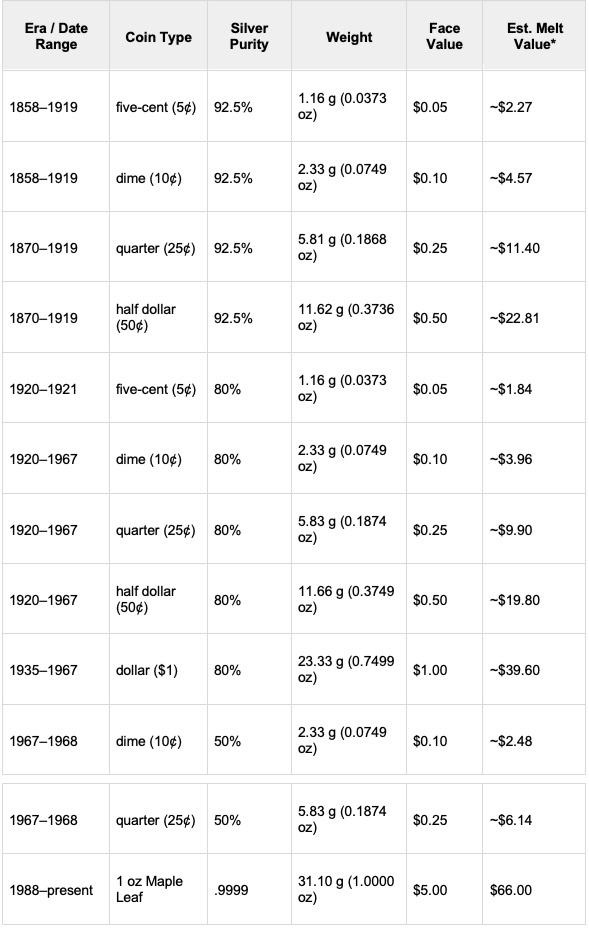
*based on a silver spot price of $66 per troy ounce
Let’s explain further what face value and melt value mentioned above mean.
- Face value is the number stamped on the coin. In other words, it’s what the coin was officially worth as legal tender when it circulated.
- On the other hand, melt value is based on the market price of silver and how much actual silver the coin contains, measured by weight and purity. It’s calculated using this simple formula:
Melt Value = (Coin Weight × Silver Purity) × Spot Price
Let’s use a sample spot price of $66 per troy ounce. Using the formula above, the melt value of a 1967–1968 Canadian quarter would then be:
Melt Value = (0.1874 × 0.50) × $66 = ~$6.10
How to Tell If a Canadian Coin Contains Silver
Check Date
Flip the coin and check the date, which is usually found on the front (obverse) side beneath the portrait. Once you’ve got the year, compare it against known silver coin years.
Refer to our Canadian silver coin summary table earlier for a quick reference.
From the table, you can see that post-1968 coins (except Silver Maple Leafs) are no longer made of silver.
So while you may come across commemorative coins that use older designs, most modern issues are struck from nickel, steel, or other base metals rather than silver.
Inspect Coin Edge
Hold the coin sideways and look closely at the edge. Solid silver coins will appear bright and uniform in color, while newer plated or nickel coins often show a copper or dull-colored line inside.
As you inspect the coin, also check for any irregularities in color, texture, or signs of base metals showing through. These could indicate that the coin is plated or counterfeit.
Do note that some modern Canadian coins can look very similar to silver. So, this test helps as a starting point but shouldn’t be relied on by itself.
Magnet Test
Use a strong neodymium magnet and hold it near the coin. If the coin sticks or moves quickly toward the magnet, it’s not real silver.
Real silver is not magnetic. So if there’s any noticeable pull, the coin likely contains magnetic metals like iron, meaning it’s either counterfeit or made from base materials.
That said, the magnet test is just an initial check to rule out obvious fakes. A coin not reacting to a magnet doesn’t prove it’s silver, since many non-silver metals, such as nickel or aluminum, are also non-magnetic.
Ring or Ping Test
Balance the coin on your finger and gently tap it with another coin. Listen for a clear, ringing sound.
A real silver coin produces a long, high-pitched "ping" or bell-like ring sound when tapped. On the other hand, coins made from base metals usually sound dull, short, or flat — more of a clink than a ring.
One caveat, however, is that heavily worn or damaged silver coins may not ring well, especially if they’ve got deep scratches, dents, or uneven surfaces that disrupt the vibration.
That doesn't necessarily mean they aren't silver, just that the sound can be muted over time.
Add to that, the ring test has a bit of subjectivity built in. Not everyone hears frequencies the same way, and depending on your hearing or environment, you might miss the subtle pitch differences.
Weight and Measurement Test
Each silver coin has a specific weight and size. Use a precision scale and a caliper to measure your coin, then cross-check the results against reputable silver coin specifications.
For older circulated Canadian coins, you can refer to guides published by groups like the Saskatoon Coin Club, which list expected weights and dimensions by year.
For modern bullion silver coins, the Royal Canadian Mint website provides official specifications you can compare against.
If your measurements are noticeably off, the coin may be counterfeit, plated, or made from a different metal altogether.
XRF Testing
XRF, or X-ray fluorescence testing, is a method that uses high-energy X-rays to analyze the elemental makeup of a coin, including how much silver is in it, if any.
The biggest advantage of this method is that it’s both non-destructive and highly accurate. It doesn’t damage the coin and provides an instant breakdown of its metallic composition.
In other words, this is one of the most reliable ways to know if your coin actually contains silver, and in what percentage.
That said, XRF machines are expensive, and using one properly requires experience.
That’s why this test is typically done by professionals like coin dealers, refineries, or numismatic experts. For most collectors or sellers, it’s not something you’d have access to at home.
Final Thoughts
In conclusion, earlier Canadian coins, particularly those minted before 1968, were made with real silver. After that year, silver was removed from the circulation coins entirely, although the Royal Canadian Mint still produces silver coins today as bullion or collectibles.
If you’ve got one of these older Canadian coins lying around, it’s definitely worth taking a closer look. You might be holding onto more silver than you think.
Frequently Asked Questions
Are old Canadian coins silver?
Yes, old Canadian coins minted before 1968 are made with silver. Dimes, quarters, half dollars, and silver dollars produced between 1920 and 1967 typically contain 80% silver, while coins minted before 1920 contain 92.5% silver.
What year did Canada stop making silver coins?
Canada stopped producing silver coins for general circulation in 1968. That year marked the full transition to base metals like nickel and steel.
Do Canadian silver coins have value today?
Yes, Canadian silver coins have value beyond their face value. Their melt value is based on the current silver spot price and how much silver the coin contains. Some coins also carry added value for collectors, especially if they are in excellent condition, have low mintages, or are part of commemorative issues.